26th May 2026 | By Eduardo Salgado Reyes
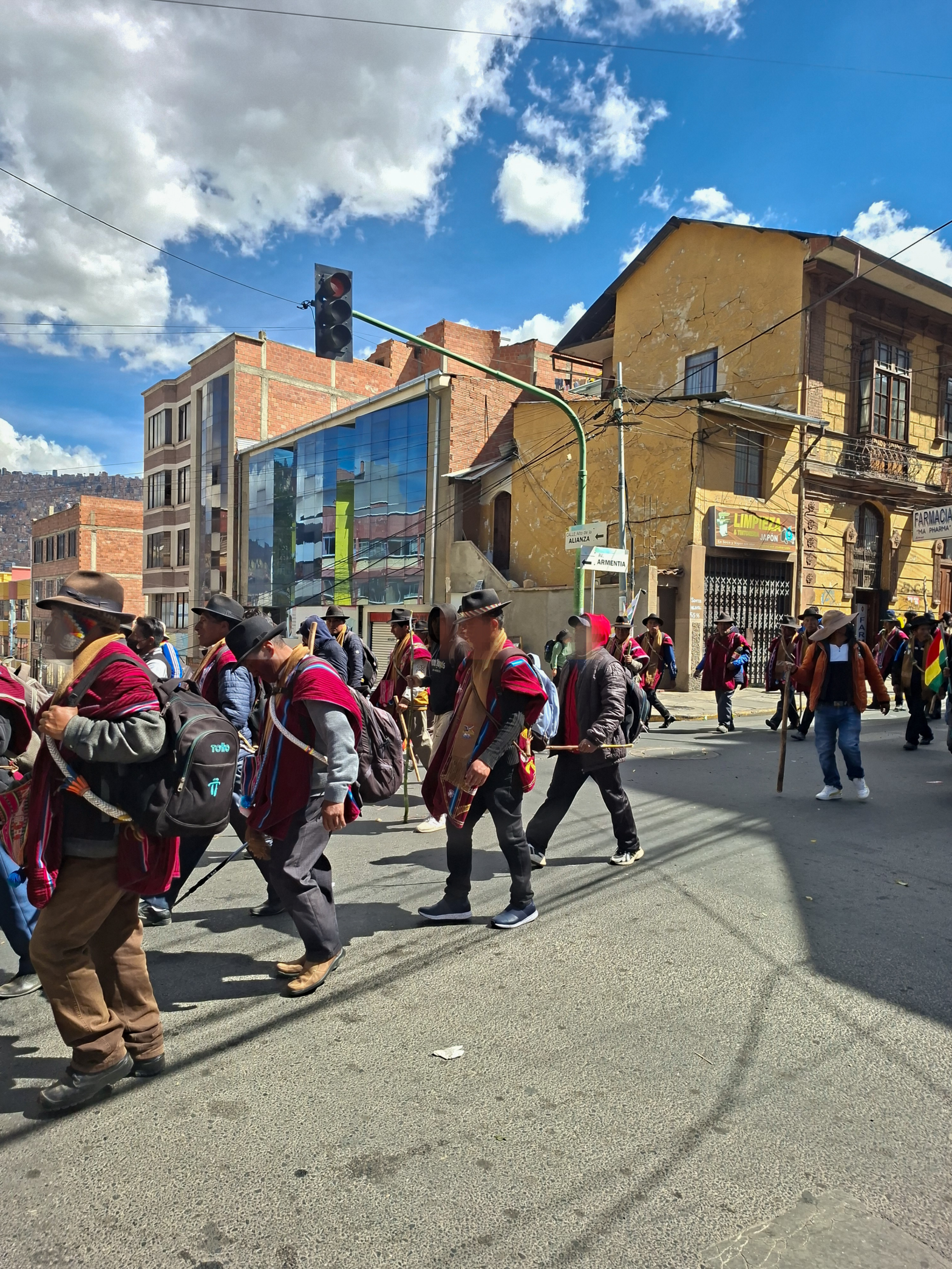
On the political chessboard of Latin America, few social forces challenge the architecture of a nation-state as profoundly as Bolivia’s Red Ponchos (Ponchos Rojos). Hailing from the province of Omasuyos in the heart of the La Paz altiplano, this Aymara movement transcends any definition of a peasant union or ethnic reserve. In 2026, they have consolidated themselves as an autonomous political actor with institutional veto power: a community militia that, when it mobilises its columns from Achacachi, can suffocate the capital, blockade the Andean borders, and force the resignation of an elected president. [1][2][3]
How did they transform into this de facto power? And what is the real reach of their influence in the convulsed Bolivia of 2026?
1. Genesis of Power: From the 1952 Agrarian Reform Militias to the “Mallku”
The might of the Red Ponchos cannot be understood without their military historical memory. Their quasi-military structure traces back to the Revolution of 1952, when the Bolivian state, after dismantling the feudal hacienda system, distributed arms among peasant unions to defend the Agrarian Reform. Many of those weapons—old Mauser and Czechoslovak rifles—remain in community hands, forging a culture of territorial self-defence that endures eight decades later. [4][5]
Their baptism of fire in the contemporary era occurred in September 2003, during the “Gas War”. Under the ideological leadership of Felipe Quispe Huanca, El Mallku, the movement adopted a radical indigenous nationalism that sought not to integrate into the republican state, but to challenge it from the autonomy of the ayllu. Through a total blockade of the altiplano, they demonstrated a truth that has conditioned every Bolivian presidency since: no one can govern La Paz if Omasuyos decides to close the roads. [4][5][6]
Their attire is not mere cultural identity; it is political-military symbolism. The intense red of the poncho comes from the wayruru (sacred Andean seed) and evokes the blood shed by ancestors in resistance against conquest. The black border represents Andean protection. Crucially, the red poncho is only worn when the community declares a state of mobilisation or “war readiness”, making its very presence a signal of war. [2][7]
2. The MAS Era: Tactical Loyalty, Not Subordination
With Evo Morales’s arrival to the presidency in 2006, the Red Ponchos moved from insurgency to tactical loyalty with the Movement Towards Socialism (MAS) government. The officialdom publicly elevated them as “guardians of the process of change”, and for almost three lustres they functioned as a civilian praetorian guard deterring opposition pressures, especially from the agro-industrial elites of the Bolivian east (Santa Cruz). [4][5]
Yet this relationship was never one of mere subordination. In exchange for their geopolitical backing, the movement obtained effective control over local governments, direct economic flows, and recognition of their community justice as legitimate authority in their territories. As Bolivian analyst Pedro Portugal, director of the magazine Pukara, notes, “structurally they are not Evo’s. In indigenous tradition, once the leader passes, he is forgotten.” [8]
This explains why, when Morales was forced to resign in 2019, the Red Ponchos did not vanish: they marched from El Alto threatening “civil war” if the new administration did not back down, demonstrating that their loyalty had always been conditional upon community interests, not partisan caudillismo. [9]
3. The 2026 Conjuncture: From MAS Guardians to State Besiegers
The present scenario represents a historical inversion. After two decades of MAS hegemony, the second-round victory of Rodrigo Paz Pereira (Christian Democratic Party) in October 2025 inaugurated an unprecedented cycle of crises. The combination of structural economic crisis (dollar shortage, falling energy production), fuel shortages after the end of subsidies in December 2025, and the enactment of Law 1720 (which allowed small agricultural properties to be reclassified as medium-sized, threatening communal land tenure) detonated a multi-sector rebellion that rapidly outgrew its initial causes. [1][10][11]
On 1 May 2026, the Bolivian Workers’ Centre (COB) declared an indefinite general strike. Although the protests were initially heterogeneous—miners, teachers, Amazonian indigenous peoples—the Red Poncho bases, historically linked to Evoismo but autonomous in action, soon occupied the radical vanguard. By mid-May their slogan was no longer the repeal of a law, but the immediate resignation of Paz. [1][12]
The level of hostility was laid bare at the Omasuyos blockade points, where one of their peasant leaders issued an ultimatum that encapsulates the new phase of the conflict:
“Rodrigo Paz, damn it!, we’ve had it up to here, there are no limits left, we can no longer stand this government. The sleeping lion has awoken to a scenario without limits.” [13]
4. Siege Strategy: Blockades, Urban Assault, and “Civil War” as Discourse
The Red Ponchos’ tactics in 2026 combine ancestral territorial control with an unprecedented urban escalation. Organised from their bastion of Achacachi—some 100 kilometres from La Paz, where a statue of Túpac Katari recalls the region’s rebellious tradition—the group executes high-impact political actions: [8][14]
- Strategic road blockades: They lead dozens of the more than 60 blockade points reported nationwide by the Bolivian Police, suffocating routes to Copacabana, Desaguadero (Peru border), and the Los Yungas valleys, isolating the administrative capital. [1][15]
- Urban siege and symbolic militarisation: Militia columns advanced towards El Alto, seizing key infrastructure in zones such as Río Seco and breaking police security cordons in La Paz. The government disseminated a video in which some twenty alleged members march in military formation shouting “Now yes, civil war!”, carrying old rifles. Presidential spokesperson José Luis Gálvez identified Bernabé Gutiérrez Paucara as “president of the conflict committee” of the group, accusing him of calling for the march “with every possible weapon”. [2][14][16]
- Destruction of the state’s monopoly on force: With no traditional centralised command, they self-convene by communities and union structures, making any vertical negotiation impossible. As Portugal explains: “It is an ancient form of communal convocation. When people mobilise, they wear the red poncho. Today that enemy is the government.” [8]
Conclusion: A State within a State?
The Red Ponchos represent the physical and symbolic limit of central power in Bolivia. By combining a quasi-military structure based on the ayllu, absolute dominion over the altiplano’s strategic routes, and a discourse of radical indigenous resistance, they operate as a de facto power within the national territory. They are neither a classic irregular army nor a conventional social movement: they are the materialisation of a parallel community sovereignty that activates when the state transgresses what they consider their ancestral rights. [2][3][6]
In the Bolivia of 2026, the guardians of Omasuyos demonstrate that the country’s most transcendent decisions are not taken solely in government palaces, but in the heat of the bonfires on the blockaded roads of the altiplano. There, where a 1952 Mauser rifle and a poncho dyed with the colour of the wayruru remain weapons of political veto. [13][17]
References
[1] Wikipedia. 2026 Bolivian protests. Retrieved 26 May 2026.
[2] TN. “Ponchos Rojos de Bolivia: cómo es el movimiento aymara que impulsa la caída del gobierno de Rodrigo Paz”. 21 May 2026.
[3] Wikipedia. Red Ponchos. Retrieved 26 May 2026.
[4] Wikipedia. Ponchos Rojos (es). Retrieved 26 May 2026.
[5] El Deber. “Ponchos Rojos apedrean tiendas y vehículos para obligar a parar actividades en El Alto”. 2026.
[6] Wikipedia. Red Ponchos (history and origin).
[7] Instagram. Reel on the symbolism of the red poncho and wayruru.
[8] Pedro Portugal, director of Pukara, cited in TN, 21 May 2026.
[9] Wikipedia. Red Ponchos (section: Bolivian protests of 2019).
[10] Reuters / AP. Reports on economic crisis and Law 1720, May 2026.
[11] El País América. “La Asamblea boliviana anula una polémica reforma agraria”. 14 May 2026.
[12] Los Tiempos. “Abrogación de Ley 1720 no calma a movilizados; piden renuncia de Paz”. 14 May 2026.
[13] Instagram. Statement by Red Ponchos leader from blockades in Omasuyos.
[14] Infocom.bo / ICC. Video of military formation and statements by José Luis Gálvez.
[15] Visión 360. “La convulsión social cumple 22 días, hay más de 50 bloqueos”. 22 May 2026.
[16] AFP / EFE. Photographs and reports of clashes in La Paz and El Alto.
[17] El Potosí. “Ponchos Rojos mantienen bloqueos contra Rodrigo Paz”. Retrieved 19 May 2026.
Discover more from SolidarioGB
Subscribe to get the latest posts sent to your email.

Good one comrade!
LikeLike