
Published by SolidarioGB. Algarrobo, Chile.
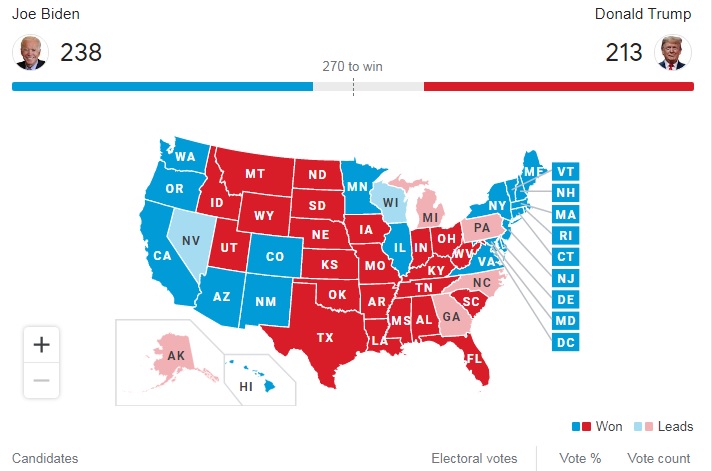
FINAL ANALYSIS BEFORE END OF POLL COUNT: There following States are still to finish counting: Michigan, Pennsylvania, Georgia, North Carolina, Wisconsin, Alaska, and Nevada. These latter two Biden is in the lead. Here, Biden would get an extra 16 Electoral Votes and added to his tally, would be 258. HE WOULD NOT REACH THE 270 TARGET.
And Trump is in the lead in the other states still to finish, where the Electoral Votes sum to 70, plus what Trump has, 213, would sum up to 283, with which he would surpass the 270 needed to win.
So if the numbers don´t vary much, TRUMP is set to win.
Michigan is neck and neck BUT even if Biden wins that one, he still doesn’t reach 270 and Trump still wins.
Trump leads in the States, leading by 3 percentage points or more.
In Alaska, Trump is leading by double percentage points, so he has won that one.
In Penn he is leading by 11 percentage points so he has probably won that one too.
So the deciding states ARE Michigan, North Carolina, and Georgia. The latter two southern states.
In the last presidential election Trump unexpectedly won Michigan by a small margin.
Since 1972 North Carolina has voted REPUBLICAN most of the time.
Since 1988 Georgia has voted REPUBLICAN most of the time.
In ALL voting history of Michigan the people have voted REPUBLICAN in IMPORTANT HISTORICAL VOTES.
FINAL ANALYSIS: TRUMP IS SET TO WIN
***END OF ANALYSIS **********
In the last decade USA has 40 million people under the poverty line, and now 170 million added to the dole. Whoever deals with the administration of the executive in the USA will not have an easy ride. Put your seat belts on America. We are heading for a meltdown and probably the start of the end for American imperialism. Expect dramatic change. The wind of change coming to their own doorstep. Pity they don´t have an embassy that can “sort it” a all out.
We add here an article from July 2020 from the NYT to describe what the new US administration will be facing.
An Extra $600 a Week Kept Many Jobless Workers Afloat. Now What Will They Do?
A supplement to unemployment benefits is at an end, and Congress is deadlocked over new aid. For some, that means hunger, evictions or bankruptcies.


By Patricia Cohen, Ben Casselman and Gillian Friedman
- Originally Published July 29, 2020, Updated Sept. 10, 2020
For Sara Gard, the government’s safety net moved smoothly into place when the coronavirus pandemic upended her family’s lives. Jobless benefit checks began arriving a few days after she was furloughed in April from an entertainment company in Atlanta. A $600 weekly supplement, part of an emergency federal program, would cover the mortgage until her company resumed operations — probably in June.
June came and went, and the reopening was pushed to August. Now August is near, the business is still shuttered and the weekly benefit booster has run out.
“When the $600 is gone, we’re going to totally have to rethink our lives because we don’t have a way to pay the mortgage,” Ms. Gard said. Without it, her weekly benefits from the state total $300. Her mortgage is $1,700 a month.
Ms. Gard is one of roughly 30 million Americans who are getting unemployment payments — a staggering figure that reflects one of the country’s most calamitous economic events.
But the stark urgency that faces families perilously close to losing their homes, skipping medical treatments or missing meals because they can’t afford food has not extended to Washington. More than two months after House Democrats approved another round of emergency relief, Senate Republicans and the White House put forward a proposal this week with far different priorities. Rather than restoring the $600 supplement, they would replace it with a $200 payment, saying the larger sum discourages looking for work.NEXT STEPSHere’s how Congress might replace the $600 unemployment benefit supplement.
The Gards recognize that they and their two children are luckier than many families. Already nearly 11 percent of Americans say they live in households where there is not enough to eat, according to a recent survey by the Census Bureau. More than a quarter have missed a rent or mortgage payment and doubt they will make the next one. Forty percent of adults have delayed getting medical care.
Ms. Gard’s husband, Matt, has kept his hospital maintenance job, and her employer of 15 years continues to pay its portion of the cost of her medical insurance.
But she has to come up with her part — $350 a month — while dealing with several other bills. “I am our family’s major breadwinner,” said Ms. Gard, 39, who had just gotten a raise that lifted her annual salary to $80,000.
They also have some savings — a comfort when more than 40 percent of American households lack cash to cover an unexpected $400 expense. That cushion was crucial last week when the Gards’ air-conditioning system suddenly died. The repair gobbled up what would have been a few months’ worth of mortgage payments.
Delaying wasn’t an option, Ms. Gard explained: “Georgia in August.”
Without further information on when she might be rehired, Ms. Gard has started updating her résumé, and reaching out to recruiters and contacts on LinkedIn.
Then her school district announced that all teaching would be online in the fall. Her mother, 71, used to pitch in to care for her children, 2 and 5, but Ms. Gard worries about the health risk, so child care is another issue.
“I have the month of August to figure out where September’s mortgage payment and everything else will come from,” she said.
As the economy falters, pain is everywhere. Assistance, though, is more uneven.
Normally, individual states run their own unemployment programs, setting different benefit levels and eligibility rules. On average, benefits replace about 45 percent of a worker’s weekly paycheck. Freelance, self-employed and part-time workers, who didn’t qualify for state benefits but received funds through the federal Pandemic Unemployment Assistance program, tended to get a much smaller fraction of their previous earnings.
That is where the extra $600 a week came in. It was meant to make up for lost income and ensure recipients had enough money to buy food, pay rent, keep the lights on, afford medical prescriptions or make car payments. Lawmakers settled on a lump sum as the quickest and easiest way to deliver assistance — given the limited capabilities of already overwhelmed state unemployment networks.
The money was crucial in supplying the economy with fuel to keep the engine going, economists say. Like any one-size-fits-all measure, however, the $600 supplement fell outside the target zone in many instances. Roughly two-thirds of workers ended up with more income than they would have earned had they not lost their jobs. The windfalls angered critics who warned of ballooning government expenditures and disincentives to work — despite a severe shortage of available jobs.
Some recipients said they could manage without the bonus. Kimberly Zaiger, for example, lost her job as a convention services manager at a hotel in San Antonio, Texas, in March. The extra money “was helpful,” she said, enabling her to offer some financial help to her grown children, but “not crucial.”
Ms. Zaiger, 52, will still get $521 a week in regular state jobless benefits in addition to a share of her ex-husband’s military pension. She also has savings and a fiancé who is working and splits some bills.
“I’ve been crunching the numbers and prioritizing and I’ll be fine,” she said.
But for others, the weekly $600 made the difference between staying afloat and ruin.
Rebecca Mallery, 46, was cobbling together a living from three jobs when the coronavirus shut the economy. She lost them all on the same day: March 15.
Her earnings had averaged less than $250 a week — compared with the $600 in supplemental pandemic unemployment assistance that arrived with her unemployment insurance.
But without any supplement, she faces bankruptcy.

She qualifies for unemployment benefits for only one of her jobs, a part-time gig conducting surveys for the Las Vegas Convention and Visitors Authority. That comes to $96 a week. With that and a small monthly disability check, she has enough to cover her $815 in monthly rent, but not much else.
A single mother with a 9-year-old son, Ms. Mallery lives just across the Nevada border in Arizona and has been looking for work. But with the tourism industry struggling, there isn’t much available.
“There’s just nothing left out there right now,” she said. Even if there were, she wonders how she would manage if schools don’t fully reopen and she has to look after her son during the day. “How do you go to work?” she said. “When you’re a single parent, that leaves you with nothing, there are no options.”
She worries that a job that involves contact with the public puts her at higher risk of exposing her mother, who has cancer, to the virus.
When the Lowe’s near her reopened, though, she quickly applied. “I was out in the garden center, shuffling around cactuses in 100-degree heat, but it was great,” she said. “I was glad to be working.” But she picked up only a couple of shifts.
With the extra unemployment benefits running out and little hope of finding steady work, Ms. Mallery is applying for subsidized housing, even though she hates to leave her townhouse, which has three bedrooms and a yard where her son can play.
“I can’t use any of my credit cards anymore — they’re all maxed out,” she said. “I’m going to have to declare bankruptcy.”
Congressional Democrats have pushed for another $3 trillion relief package that would preserve the $600 weekly supplements through January. Senate Republicans and the administration have countered with a $1 trillion proposal that would reduce the extra benefit to $200.
That smaller sum would more than replace what Ms. Mallery earned from her three jobs before the pandemic. Other workers, though, would be left without enough to cover the essentials.
In Chicago, more than 1,700 miles away from Ms. Mallery’s home, Grey Parker has been trying to map out a budget for the next few months.
Before the pandemic, he had snagged his dream job, a quality control engineer at Production Resource Group, one of the largest live-entertainment production companies in the world.
As coronavirus lockdowns shut down one live event after another, Mr. Parker was furloughed. His wife’s part-time work cleaning houses dried up as well.
His package of jobless benefits, including the supplement, replaced about half of their $80,000 to $90,000 annual income.
Money was tight, said Mr. Parker, who has a 6-year-old daughter, but “we weren’t worried about food, and we weren’t worried about rent.”
Without the extra weekly benefits, Mr. Parker will receive $350 a week. He contacted his utility company to set up a deferred payment plan and arranged to start receiving food from local food banks.
But he can’t figure out how to keep paying the $1,800 rent for his house beyond September.
“We are now facing potential ruin within a couple of months,” he said.
He also worries about his health. Mr. Parker, 50, has a vascular disease called thrombosis, a blood-clotting disorder that puts him in a high-risk group for complications if he were to contract Covid-19. Even with the $600 supplement, he didn’t have enough money for the $240 monthly cost of continuing his health insurance.
Without insurance, though, the cost of the daily medication he takes to prevent blood clots rose from $10 a month to $500 — far more than he could afford. In the first few weeks of his furlough, he rationed his medication, taking only half the amount he needed, which gave him a frightening series of symptoms: bruising, dizziness and an increased risk of stroke. He recently qualified for emergency assistance from the pharmaceutical company Bristol Myers Squibb, which will provide a 90-day supply. After that, Mr. Parker is unsure of what to do — maybe ask for donations through GoFundMe.
This week, just after the final jobless benefit supplements were sent out, Mr. Parker learned that his company was extending the furlough through September. He hopes to return to work, but doubts that the live-event industry will be back in the fall. Even if it is, he said, his medical condition will make him think twice about returning to work before a vaccine is available.
The weekly $600 premium was a life preserver. “It gave us our one sense of security,” he said. “Now that’s gone.”
Source: New York Times.
Preparing for ‘the Interregnum’ — the election mess – a WW commentary
By Teresa Gutierrez posted on September 30, 2020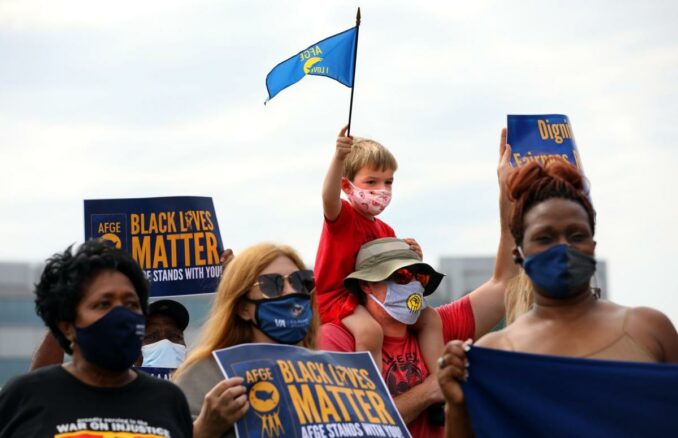
Labor Day protest for fair contracts, Sept. 7, Washington, DC.
In researching this article, a cool-sounding word came up: “pettifoggery.”
It means “given to quibbling over trifles.”
The word was used in an article by Barton Gellman in the November Atlantic magazine, “The Election That Could Break America.”
Gellman’s point is that it is a waste of time to quibble over whether the 45th president of the United States will leave office on Inauguration Day – Jan. 20, 2021. He makes an exceptionally sound case that, no matter what happens on Election Day – Nov. 3, 2020 – Donald Trump will not concede his position.
Gellman writes that “two men could show up on the 20th to be sworn in. One of them would arrive with all the tools and power of the presidency already in hand.”
No one has a crystal ball, but let’s face it, Gellman is probably right.
Donald Trump’s hubris as well as his pathology absolutely will not allow him to leave easily or quietly. Every tweet, statement, decree – every action of Trump since the 2016 election – has demonstrated his fierce hunger for staying in power, in the limelight and reaping the bounty for him and his family that comes with the presidency.
According to Gellman, Joe Biden and others have “misconceived the nature of the threat.” They say that if Trump refuses to leave the Oval Office, “the proper authorities will escort him from the White House with great dispatch.” Gellman argues that this hope is not enough.
Gellman’s piece covers all kinds of articles that have been written, studies carried out and even conferences held among legal and social scholars about the 2020 election. Constitutional scholars especially have examined multiple scenarios that could play out between Nov. 3 and Jan. 20 – a period Gelman calls “the Interregnum.”
That is the term for a period, especially between successive reigns or regimes, when normal government is suspended.
A police coup?
Gellman argues that even if there is seemingly a landslide vote on election night, the tabulation of mail-in votes, etc., could mean the final outcome is not determined for “days or weeks.”
The transfer of power in January has not received this much attention in generations. Even the U.S. military has weighed in.
On Sept. 25, in an article headlined “At Pentagon, fears grow that Trump will pull military into election unrest,” the New York Times reported: “Defense Department officials said top generals could resign if Mr. Trump orders the active duty military into the streets to quell protests.” In remarks released last month, one general said, “I believe deeply in the principle of an apolitical U.S. military.”
Trump might not need to worry about armed support, however. He may not have enough to carry out a military coup – but his relationship with the police of this country is solid.
Trump has threatened on more than one occasion to mobilize “law enforcement” to poll watch on Election Day – an ominous threat, especially for Black and Brown people. Imagine the same agency that murders Black folks with impunity watching over their shoulder as they vote in Georgia or elsewhere.
In addition, the Republicans, according to Gellman, are “recruiting 50,000 volunteers in 15 contested states to monitor polling places.”
Think of that. The Republican Party watching over polls. This is the same party that in 2009 produced the Tea Party, the group of ultra-conservative zealots who eventually came in from the fringe to become what the Aug. 13 New York Times called an “enduring force” in U.S. conservatism.
This is the same party, the Times noted, that is determined to consolidate and cater to an “older, whiter, more male, more rural, more conservative” base.
And to worry more, the same Republican Party recruiting 50,000 “poll watchers” also just endorsed three candidates in California who support QAnon far right conspiracy theories! (Sacramento Bee, Sept. 28)
The role of revolutionaries and socialists
So, what do revolutionaries and socialists do – those who as Marxists understand that both parties represent the capitalist class, that the obscene donations from PACS and billionaires outweigh the influence of labor or any working-class interest group in a bourgeois election?
If the Democrats really were for the working class, they would overturn anti-union legislation. They would support union drives and the call for a general strike against racism, as some bold labor activists have already done.
They would move heaven and earth to make the oil companies pay for climate change. They would socialize healthcare. If Canada can do it, why not the U.S.?
They could call for a strike in Congress and in the streets to demand COVID relief. They could demand that the police who killed George Floyd, Breonna Taylor and so many other victims pay for their crimes.
If they truly represented the interests of the people, the Democrats in Congress would shut down Washington until the police were punished or COVID money released.
But they do not. And they will not.
If Wall Street controls the elections, Congress and the White House, what can those who live on Martin Luther King Street, Cesar Chavez or Main Street possibly do to influence the elections?
Everything.
‘The transfer of power to the people’
Whatever happens in November, whoever wins the election, workers and oppressed people must organize and fight back. If ever there was a time for a movement for Worker Assemblies, this is it.
CNN and Fox News may have all the cameras aimed at the White House in November, but if the pitchforked masses are in the streets striking for what we need, all those cameras will turn toward the people.
To those scholars concerned about the defense of the Constitution during the Interregnum, we must ask where was the concern for the Constitution when George Floyd or Breonna Taylor lay dead?
What about the constitutional, human and civil rights of the migrant women who have been forcibly sterilized?
And what about all the essential workers who cannot work from home, those forced to risk exposure to COVID because neither the capitalist system nor the two capitalist parties represent them?
And all the hungry, houseless, incarcerated, impoverished masses—who is fighting for their constitutional rights?
Clearly, only the people can fight for themselves. That is the lesson of November.
The only transfer of power the masses must be concerned with is the transfer of power to the people: humanity depends on it.
Source: Worker’´s World
Discover more from SolidarioGB
Subscribe to get the latest posts sent to your email.
