55 years | Solidariogb | 7th September 2026
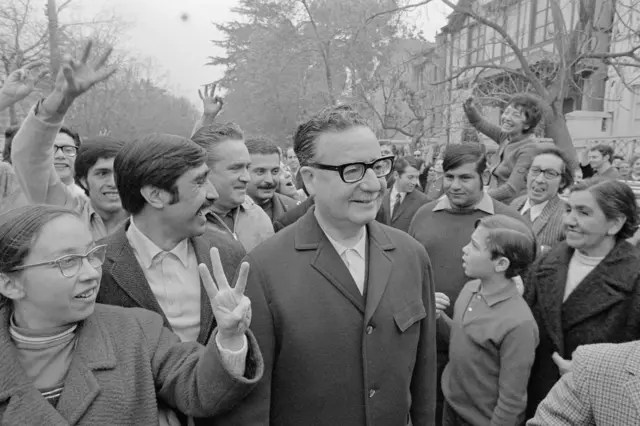
It’s been 55 years since the rise of Salvador Allende’s Popular Unity government in Chile. His government lasted about three years until a coup toppled it in a bloody coup on 11 September 1973.
Factual summary recognising both the aspirations and the severe limitations of the Allende government, as well as the role of external and internal forces.
1. The Unidad Popular Coalition and Initial Reforms
- Allende, a socialist, led the Unidad Popular (UP) coalition, which included Socialists, Communists and other left-wing parties. He won the 1970 election with a narrow plurality (36.6% of the vote), not a majority, and was confirmed by Congress after agreeing to a “Statute of Constitutional Guarantees”. He won on his fourth attempt, after the CIA had spent millions trying to prevent him from reaching power.
- His first year saw significant wage increases (averaging around 40%), price controls and expanded coverage in education and healthcare. These measures initially boosted consumption and reduced poverty.
- The UP also initiated a rapid process of nationalisations, especially of copper mining – the backbone of Chile’s export economy – which was largely in the hands of US companies (Anaconda, Kennecott). This was done with legal compensation, but the US considered it a serious violation of property rights. (Later, the military found it convenient to maintain the nationalisation, as it funded the entirety of the armed forces and their pensions. In fact, the military have been the sole beneficiaries of this measure introduced by President Salvador Allende.)
Social measures to support the people
- Half-Litre of Milk Programme: One of the most emblematic policies of the Allende government, included as measure 15 of its 40-point programme. The programme consisted of the daily, free distribution of half a litre of milk to all children under 15, pregnant women and nursing mothers. The target was to distribute 4,000 tonnes per month, equivalent to 80 million rations per month. The impact was notable: whereas in 1970 only 650,000 people received milk through complementary programmes, by 1973 the figure had risen to 3.6 million beneficiaries, with 49 million litres of milk distributed. The campaign succeeded in significantly reducing rates of malnutrition and infant mortality; for example, at the Roberto del Río Hospital, the percentage of children under two suffering from malnutrition fell from 60% in January 1971 to 12% in June of that same year. The milk was imported mainly from European countries such as Belgium and the Netherlands, and was distributed through the National Health Service (SNS), schools (via JUNAEB), clinics, Mothers’ Centres and Neighbourhood Associations.
- Universal healthcare: Hospital equipment was improved, and preventive and community social medicine was promoted throughout the country.
- Education: Preschool, primary and industrial education were promoted, and access to university was expanded. The most emblematic project in this area was the Unified National School (ENU). Literacy and health education campaigns were also promoted, targeting rural populations.
- Housing: Priority was given to the construction of social housing for those living in shantytowns and land occupations.
- Agrarian reform: The agrarian reform process was deepened, achieving the expropriation of more than 4,400 estates, not counting more than 2,000 occupations carried out by agricultural workers.
- Culture and labour rights: The publishing house Quimantú was created, the New Chilean Song movement was promoted, and workers’ rights and trade union organisation were strengthened.
The Communist Party (Proletarian Action) and its critique of the UP process
- It is important to note that not all of the Chilean left supported the Unidad Popular path. A relevant antecedent is that of the Communist Party (Proletarian Action) [PC(AP)], which, although formally constituted in 1979 during the dictatorship, has its ideological roots and its critique of the Allende process in the tradition of the Revolutionary Communist Party (PCR), which was active at the time.
- The PC(AP) defines itself as a anti-revisionist Marxist-Leninist organisation, which implies an orthodox defence of the principles of Marx, Engels, Lenin and Stalin, and an outright rejection of what it considers deviations from “scientific socialism”. From this perspective, they describe Allende’s “peaceful road” as “non-existent” and analyse the defeat of September 1973 in their article “Revisionism, the Gateway to Fascism”, arguing that trust in the bourgeois state apparatus and in a peaceful transition was a strategic error that facilitated the military coup.
- For the PC(AP), the Communist Party of Chile – which was indeed part of the UP – had fallen into “revisionism” by abandoning revolutionary struggle and the dictatorship of the proletariat in favour of the strategy of “peaceful coexistence” promoted by the Soviet Union after the 20th Congress of the CPSU. Similarly, they criticised the Socialist Party and other sectors of the UP for their “opportunism” and their “petty-bourgeois practice”, accusing them of using social mobilisation for their own benefit rather than for the interests of the working class.
- In their later analyses, the PC(AP) maintains that Allende, by failing to create parallel “popular powers” or to resort to armed insurrection, remained tied to an institutional framework that the opposition and the armed forces would ultimately use against him. Their central tenet is that socialism cannot be built solely through bourgeois elections, and that a “democratic and popular revolution” is necessary, which may ultimately include armed popular insurrection.
2. US Opposition and Economic Warfare
- It is historically documented that the Nixon administration and the CIA viewed Allende as a threat to US interests in Latin America and actively acted to “make the economy scream” in order to prevent his consolidation or inspire a coup. Declassified US documents confirm:
- Covert funding for political opponents, strikes and media outlets (for example, El Mercurio).
- Pressure on international financial institutions and private banks to cut off short-term credit to Chile.
- Encouragement of copper price manipulation and disruption of spare parts supplies for Chilean industry.
- However, the Chilean economic crisis was not exclusively due to US actions. Internal factors played a major role:
- Runaway inflation (which exceeded 300% by 1973) due to massive money printing to fund social programmes.
- Hoarding, black markets and a sharp fall in agricultural and industrial production as private investors lost confidence.
- A bitter conflict between the UP government and the opposition-controlled Congress, which blocked key fiscal measures.
3. Allende’s “Peaceful Road” and Internal Divisions
- Allende was a democratic socialist who insisted on respecting Chile’s constitutional framework. He did not create parallel “popular powers” (such as militias or revolutionary tribunals) as some in his coalition urged, nor did he fully expropriate all large estates or foreign assets beyond copper, banking and a few monopolies.
- His “half-measures”, as left-wing critics saw them, were deliberate: he believed that socialism could be achieved through elections, the rule of law and pluralism. This earned him respect abroad, but left him without institutional power to counter a hostile judiciary, an adverse Congress and an increasingly uncomfortable military.
- By mid-1973, the country was polarised. Massive pro- and anti-government marches coexisted with violent street clashes. The military, traditionally apolitical, felt increasingly alienated as the UP encouraged workers’ occupations of factories and farms.
4. The Coup of 11 September 1973
- The military coup led by General Augusto Pinochet was brutal and had the tacit support of the US government, although the degree of direct CIA involvement in the final assault is debated among historians (the CIA had cultivated military contacts but was surprised by the timing).
- Allende died in the La Moneda palace, reportedly by suicide with a rifle given to him by Fidel Castro, rather than surrender. His famous final speech – from which the opening quote is taken – explicitly rejected resigning and promised to resist “even at the cost of my life”.
- The subsequent Pinochet dictatorship (1973-1990) implemented neoliberal economic reforms (the “Chicago Boys”), reversed nationalisations and committed serious human rights violations, including torture, executions and forced disappearances of thousands of leftists.
5. Historiographical Consensus
- Most historians agree that:
- Allende’s overthrow was a tragedy for Chilean democracy, driven by a combination of US interference, domestic economic mismanagement, political polarisation and military ambition.
- The US bears significant moral and political responsibility for destabilising a democratically elected government.
- However, Allende’s own policies – especially price freezes and expropriations without compensating productive capacity – accelerated inflation and shortages, eroding his support among the middle class.
- The claim that “US sanctions alone” caused the crisis is an oversimplification; internal strikes (for example, by lorry owners, professionals and copper miners) were equally paralysing, and many were funded by the CIA, but they resonated because real economic grievances existed.
Conclusion:
Allende’s experiment remains a powerful symbol of the tension between democratic means and revolutionary ends. His belief in a “peaceful road” was not a mistake in principle, but in practice it proved insufficient against a hostile domestic elite, a polarised society and a superpower determined to prevent a second socialist state in the Western Hemisphere. His legacy is debated: to some, he is a martyr for social justice; to others, a well-intentioned leader whose policies outpaced institutional reality. The truth lies in the tragic interplay of all these forces.
Discover more from SolidarioGB
Subscribe to get the latest posts sent to your email.
