8th March 2023
Sabotage of forest machinery and property fires have occurred in La Araucania and Biobio regions, where logging companies exploit territories stolen from Mapuche people.
On Tuesday, Chile’s Lower House approved for the 19th time to extend the “State of Exception” for security reasons in La Araucania and Biobio regions for 15 days to fight violent acts caused – allegedly – by territorial disputes.
This initiative allows the army deployment in the area to help the repressive Military police (Carabineros) control the area and monitor the main roads. This measure also suspends constitutional rights, including the freedom of assembly and movement, in those regions.
Recently, sabotage of forest machinery and property fires have occurred in La Araucania and Biobio regions, where the Chilean state took some territories belonging to the Mapuche Indigenous people during the 19th century and gave them over to logging companies.
“Currently, companies control most of our territories. Their activities, which have caused desertification, droughts, fires, and pollution of our lands, generate a progressive and systematic extinction of our culture,” the Mapuche Permanent Mission to the United Nations said.
The Mapuche mission considered that the State of Exception does not counteract violence but only boosts militarization and the violation of their community’s rights.
The Araucania Region is also under a state of exception for catastrophe reasons due to the massive forest fires. Chile’s Corporacion Nacional Forestal (CONAF) detected that some of these fires were intentionally provoked.
“There is an urgent need to identify and prosecute those responsible for the fires, which already threatens the delicate security situation in La Araucania,” Interior Minister Carolina Toha pointed out.
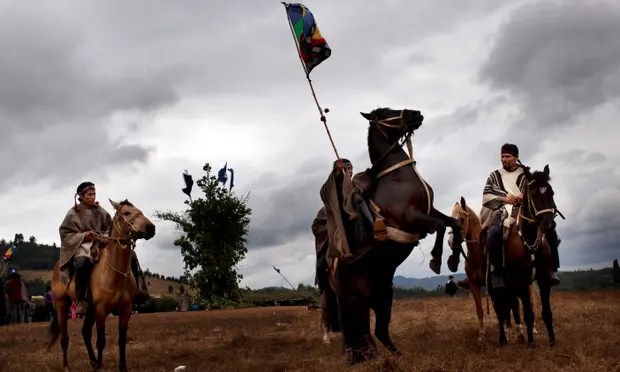
Indigenous Chileans defend their land against loggers with radical tactics
“We burned these forests as an act of legitimate resistance against the extractive industries that have oppressed the Mapuche people,” says Hector Llaitul. “If we make their business unprofitable they move on, allowing us to recover our devastated lands and rebuild our world.”
This year has already turned out to have been a particularly combustible one in a decade of rising attacks by indigenous Mapuche activists against the Chilean state and big business. Over several few days in April, crops were burned, roads were blocked and 16 forestry vehicles were set ablaze outside of the regional capital, Temuco.
Such actions have become more and more common. According to statistics published by a local business association, there were 43 attacks in the region in 2017, mainly arson attacks against logging firms.
“Anyone who hasn’t been in the Chilean forest doesn’t know this planet,” wrote Pablo Neruda, who grew up in the region – and whose verse was inspired by its wild landscapes, and the indomitable spirit of its native people who were only conquered after Chilean military campaigns in the late 19th century.
Today, however, much of the west of the region would be unrecognizable to Chile’s finest poet. In the last 50 years, monoculture pine and eucalyptus plantations have replaced the biodiversity of the original forests.
Meanwhile, Mapuche groups have become increasingly aggressive in their efforts to reclaim ancestral lands and gain political autonomy. Llaitul is a spokesman for the Coordinadora Arauco-Malleco (CAM), an anti-capitalist organization that uses direct action and sabotage tactics.
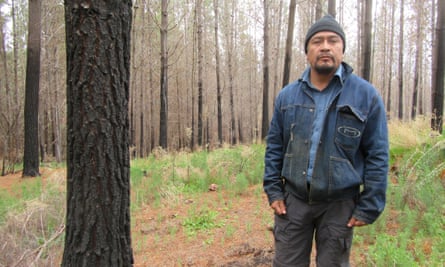
Cordova began a hunger strike in January after officials denied his request to complete a religious ceremony outside of the prison. He temporarily suspended the strike in April to negotiate.
“The government practices and respects Catholicism but it discriminates against Mapuche spiritual beliefs,” he said from a hospital bed, guarded by police officers. “The Mapuche have been impoverished spiritually, culturally and economically by Chile. I’m willing to sacrifice my life for my people.”
Today, however, much of the west of the region would be unrecognizable to Chile’s finest poet
But Cordova’s conviction in the high-profile Luchsinger-Mackay case has made it tougher to win public sympathy for his cause, said Nicolas Rojas Pedemonte, a professor at Alberto Hurtado University in Santiago and author of a new book on the Mapuche conflict.
“That case was an inflection point for the conflict,” he said. “It was the first fatal attack, it turned Chilean media against the Mapuche and was used by the state as a Trojan horse for a repressive response.”

Discover more from SolidarioGB
Subscribe to get the latest posts sent to your email.
