By Myriam Reyes-Pena. Litoral de los Poetas.
Published by SolidarioGB. 28 September 2020. Algarrobo, V Region, Chile.
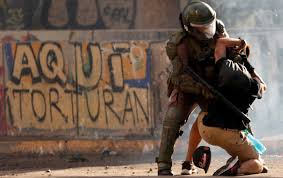
Living in Chile, after a long time of exile abroad and social exile since then, there came a plague. It went all over the surface of Earth, following the Sun, following the Moon, the whole of human kind shuddered in fear. It went on its way leaving in its wake, for months, on and on, sickness, death, but no more death than hunger, let me say. It was a time with the sound of chants, cries and screams, of lost eyes and lost lives, rape, human rigths violations, imprisonment of the manifesting people, the citizens of this country, calling for justice, calling for punishment.
COVID-19 was called this plague. It uncovered sicknesses so far ignored, they were not the symptoms of the plague, These were unkown then. They were the sicknesses humand kind had already suffered for a long, long time and were not noticed, or were willfully ignored. These sicknesses were hunger, no access to healthy food, no access to quality, free for all, education, no access to quality, opportune, health services, no access to proper housing, or housing at all. The list is endless. COVID-19 uncovered inequality, hidden poverty, the country’s authorities crude neglect of their duty, the unbelievable lies, the false promises of “better times”, of the citizens living in a country in full social justice and happines. But, meanwhile, the citizens only had in sight the living in plenty of the golden minority who rejoiced amid debauchery, financial crime, and complacency in a country where, 63% of the population live in poverty while the authorities try to convince them that over 60 % of the population is middle class. But there is no denying to the fact that most of the people in a country where its President invokes a Christian God, in a letter sent with a meagre card box with food five months late at least, are living the war against poverty, injustice, and lack of love.
Hunger, sickness, debt, lack of opportunity to access quality education, fair access to health, debt were all they had. While living in squalor, the people think about their country´s government they ask: doesn´t it remain you of ancient times, of Nero´s government in far away Europe? We are living under the government of a delinquent, an assassin with no conscience and very likely insane. People will uprise again.When voices go silent, the ululating and angry notes of the wind´s flaute come hitting the poplar trees. Poplar trees that gallop with the wind crossing the meadows of my childhood. Poplar trees that with sinuous movement avoid the southern wind´s hits during winters in which the man, alone in the vast house, watches at the waters in the river, while looking inwards, waiting for the arrival of summer which will bring the hordes of visitors that people his dreams during the long winter.
The grave sound of the northern train, howling to announce its arrival, let the captain of the Chulao know that his cargoe has arrived. Then, the steam ship goes down the river looking for river ports, laughter and anxiuos expectation. Its whistle announces its arrival to the corageous descendant of the frontiersman left there to work and administer the Mapuche land while exploiting the humid, cold forest’s autochthonous trees. If in luck, parcels with outdated newspapers, accompanied by a letter from a grateful brother-in-law, will arrive to make the long winter evenings more bearable.
Summer’s arrival will bring the children under the care of his wife who, under the pretext of “the children need to go to school”, left him under the care of his mayoral and his wife, the only human contact in his empty home. He was the river port’s captain, the Peace Judge, the reader of the correspondence his illiterate neighbours received and a great player in long, lonely unending chess games. During long summer evenings, at sunset, he sits by the cane table, in the beautiful gallery with view over the river; once again reading the month old newspaper his visitors brought him. Another month of noisy, vociferous sounds of shouting and infantile laughter, and then they will be gone, he thinks.
In March the school year starts. He will be alone again. Expectant, in anticipation, he waits for the arrival of silence, save for the morning sound announcing the arrival of the steamship which, on its way to the sea, will let him know whether it is bringing mail; the only sound to interrupt that now well loved silence. The day goes out quickly while he is busy preparing the wood logs he will embark in the afternoon, when the Chulao comes back up river. He has already written the letters his neighbours dictated to him. He already gave them his opinion on their ailments and he prescribed them the potions he prepared and sold them. His farmacy studies have rendered good fruit. He was the first child in a numerous family. He no longer is in speaking terms with his father.
What dark secrets hid in that long silence? I only know that he was my uncle, a cultivated, calm man. The harvest he got every summer was plentiful, the table was generous, and in the mysterious orchard at the back of the house I sat on the apple tree silently gazing over the green, plated, dark waters of the river. Enjoying the morning light, the silence and solitude. “The Chulao is here”, the maid said, while starting to run down towards the river port. The children noisily would start running after her to find out what the steam boat brought to them in its entrails. Such a strage ship, with wheels on both sides, as if they were wings. There was also the other one, the one with the wheel at the back.
The sounds of summer. I remember the silent sound of death from the many sheep which ended up in the oven. Only that, their throad-slashed sheep eyes screamed in horror with total understanding of their hapless fate, while the adults in the family happily looked forward to the feast of eating it. The violent process of making the sheep swallow hot seasonings was followed by the slashing of the throat. Blood would spurt from an aorta cut by the knife in a very precise and unfeeling manner. Such affront was preceded by the insult of hanging the sheep from its back legs, head hanging down. Bowls waited underneath the sheep exhibiting finely cut onions, coriander and hot peppers. There the hot blood would fall to later be consumed amid gestures and words of delight. Ñachi was called this concoction. Powerful effects were atributted to it. Macho men were made more virile. Weaklings were made stronger. Among the later were us, the children. I did not wait for the finale of this spectacle. I used to silently disappear, waiting until everyone was sitting at the table to come back and be reunited with such savages. Among so many children my disappearance was not noted, so nobody knew I did not share in their enjoyment of ñachi.
Meat was another food I hated. It was like wet cotton, it was like leather, it was a corpse! I also did not like the flying kind of animals, otherwise called chicken, etc. What caused me most horror was the silence of their death and the scream in their eyes Intriguing and silent was the sound of the oars during fishing expeditions at night, under a full moon. A muted cracking sound would occur from time to time when the oars left the water. “Silence”, would say my uncle, “you are going to make the fish go away”. Amid suffocated laughter and mutted whispers we expectantly waited for salmon to bite. Delighted, proud we would go back from our nocturnal expedition if in our hands we exhibited our prey.
In our pre-teen years, stealthy steps took us to the warehouse, early in the morning, to secretively take the oars to go to the shop, which was two hours away, up river. We went there to buy the forbidden cigarretes, Lechuga cream and assorted sweets. We had to be back before lunch otherwise a hunt for us would start. At eleven and twelve years of age they called us “children”, us: the mature consumers of cigarretes Camel. Until this day my cousin is an addicted smoker. Another day I will tell you why I don’t like cow’s milk.
Discover more from SolidarioGB
Subscribe to get the latest posts sent to your email.
