11 October 2024
Many believe that the current state that preserves Power in Chile consists of all the citizens of this country. What is not talked about is that justice, education, health, housing, recreation, and work are assumed by first-, second-, and third-class citizens, depending on the Power that governs our lives today.
The Hermosilla case demonstrates the collusion between the Judiciary and the Executive, which are nothing more than puppets of the economic Power of the great anti-national oligarchy that governs us.
The Legislative Power is another lackey of economic Power. Just look at the Fishing Law, the collusion of deputies and senators with companies that benefit from laws made to their measure in Parliament. The Fishing Law and the deputies of SOQUIMICH are evidence of this. Not just now, but for quite some time.
The Executive Power approves treaties like the TPP11 in favour of large European and American capitals, not for the benefit of national industry, giving away our copper, lithium, and other minerals to be processed in third countries.
The Republic of Chile is a dream; the separation of the powers of the State is a fantasy, as they are all subjects to the economic interests of the anti-national oligarchy.
Only in the hands of hardworking, dedicated Chileans can we know who to believe when they speak, and who finances them and why. Without that, we won’t know the intentions behind each speech.
Demos: People / Kratos: Power. The Power of the People, or Democracy, is non-existent in our country. Being called to vote every four years, when the economic Power has already shaped the candidates through the media, is NOT DEMOCRACY. Democracy is when Chileans manage our own destiny.
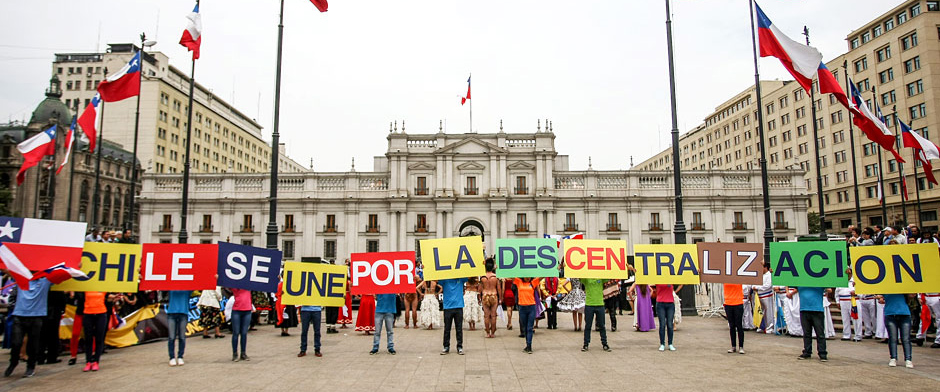
Only the fight for the Refoundation of Chile will open the way to a new democracy, one that is popular and centred on national sovereignty. Our path in the communal struggle is just part of the fight for national liberation.
Critical view
This text presents a highly critical view of the Chilean state, suggesting that the current democratic framework is a facade controlled by an economic oligarchy. It contrasts the ideals of democracy—where the people hold real power—with the author’s perception that Chile’s political system is deeply corrupt, with all branches of government (Judiciary, Executive, and Legislative) acting in the interests of foreign and domestic elites rather than the Chilean public. The text contrasts two visions: one of a captured state that benefits a privileged few and another of a people-powered democracy that the author aspires to establish through struggle.
In the UK, there are similar debates about democracy and the influence of economic elites, especially concerning lobbying, media influence, and privatisation of public services. However, the UK’s democratic institutions, such as the parliamentary system and judicial independence, are often seen as more robust, though not immune to criticism. The UK has a longer history of institutional checks and balances, whereas this text highlights the fragility of Chile’s democratic institutions, implying they have been consistently undermined by economic interests. Both contexts share concerns about inequality and representation, but the Chilean case, as described here, frames the problem as far more severe, with democracy portrayed as almost entirely non-functional.
Conclusion
The text paints a bleak picture of Chilean democracy, claiming that all state powers are subservient to a foreign-controlled oligarchy, leaving the populace disempowered. For a UK audience, accustomed to their own democratic challenges, this might resonate in terms of the role of money in politics and media manipulation. However, the severity of the situation described in Chile, where democracy is said to be virtually non-existent, might seem extreme compared to the UK’s relatively stable, albeit imperfect, democratic system. The call to refound Chile through popular struggle reflects a revolutionary sentiment that contrasts sharply with the gradual reformist approach typically seen in UK politics. The comparison reveals differing degrees of democratic dysfunction, but common concerns about the gap between the ideals of democracy and the realities of power.
Discover more from SolidarioGB
Subscribe to get the latest posts sent to your email.
