News and analysis from the perspective of the imperialism-socialism correlation of forces
20th May 2026 | SolidarioGb | Latinamerican News
Bolivia is experiencing in May 2026 its most severe political crisis in decades. The government of Rodrigo Paz, inheritor of the MAS model, has faced a wave of mass protests that began with opposition to Law 1720 and escalated into demands for the president’s resignation. This article offers a panorama of recent news, its immediate antecedents, and an analysis of the forces in play, without attributing to any of them the capacity for revolutionary direction at present.
Annulment of Law 1720
On 13 May 2026, President Rodrigo Paz announced the annulment of Law 1720, which had permitted the mortgaging of small agricultural properties as bank collateral. The law, promoted by the IMF and World Bank, was interpreted by peasant and indigenous organisations as a mechanism of dispossession. The social response was immediate:
- 67 highways blocked across the national territory.
- More than 5,000 lorries stranded, according to reports from the Chamber of Transport.
- Estimated losses of $50 million daily in commerce and exports.
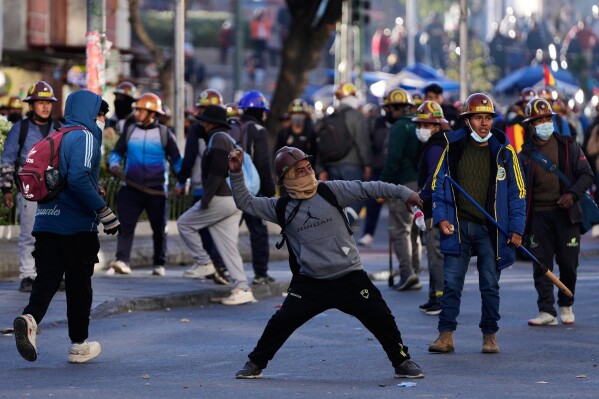
- Siege of the Government Palace in La Paz, with reports of dynamite explosives used by miners.
Paz annulled the law, but the protests continued. The Bolivian Workers’ Centre (COB) and regional federations maintained the stoppage and demanded the president’s resignation.
Position of the US Embassy
The United States Embassy in Bolivia issued travel alerts and, in an official communiqué, defended Paz’s efforts “to restore order for the peace, security and stability of the Bolivian people”. The US position has been interpreted by analysts as explicit backing for the government of the day, in a context where Bolivia possesses the second-largest confirmed lithium reserves in the world (23 million tonnes in the Salar de Uyuni).
Statement from Evo Morales
Former president Evo Morales was accused by Paz’s allies of “instigating the protests”. Morales, who faces an order to appear in court for alleged people trafficking, has not publicly assumed direction of the movement. From his circle there have been calls for “dialogue” and “MAS unity”, without proposing an alternative government programme. The Bolivian judiciary declared Morales to be in rebellion for failing to appear at a scheduled hearing.
Situation of the Army and Police
Up to the closing date of this article, the Bolivian Army has not intervened massively in the repression of protests. Analysts attribute this hesitation to the memory of the Sacaba and Senkata massacres (November 2019), where military repression against indigenous demonstrators triggered the fall of Jeanine Áñez’s government and laid the basis for the MAS’s return in 2020. The police, for their part, have attempted without success to clear highway blockades in various departments.
Antecedents: From Rentier Bonapartism to Collapse
The Paz government does not emerge from a vacuum. It is the product of a sequence of crises of the political model inaugurated by the MAS in 2006:
| Period | Government | Characteristics | Result |
|---|---|---|---|
| 2006–2014 | Evo Morales | Commodities boom; hydrocarbon nationalisation; rent distribution via bonuses and social missions | Sustainable while high gas and mineral prices lasted |
| 2015–2019 | Evo Morales | Price collapse; electoral fraud denounced in October 2019; Sacaba and Senkata massacres; Morales’s resignation under military pressure | Interregnum of Jeanine Áñez (2019–2020) |
| 2020–2025 | Luis Arce | MAS return; internal Morales-Arce rupture; attempted coup by General Juan José Zúñiga (June 2024); progressively deteriorating economic management | MAS fracture; historic electoral defeat in 2025 (candidate Eduardo del Castillo obtained 3% of votes) |
| 2025–present | Rodrigo Paz | Succession without solid electoral base; attempt to implement Law 1720 under IMF pressure; current legitimacy crisis | Mass protests; government in survival situation |
The sequence shows a progressive erosion of the MAS’s capacity to mediate between classes through the distribution of extractivist rent. Without commodity bonanza, the model loses its co-optation mechanism and exposes itself as what it always was: a form of dependent capitalist management that did not alter property structures or subordination to the world market.
Analysis of the Forces in Play
The Paz Government
Rodrigo Paz heads a government without its own social base. He was not elected by an overwhelming majority; he assumed office in a context of MAS fragmentation and absence of a viable right-wing alternative. His attempt to pass Law 1720 reveals a structural dependence on international financial institutions (IMF, World Bank) that condition access to sovereign credit. The annulment of the law, far from strengthening him, demonstrated his weakness in the face of social pressure.
The Bolivian Workers’ Centre (COB)
The COB leads the current protests, but its historical direction is marked by reformism. During Morales’s government, the COB was co-opted through the distribution of subsidies and the incorporation of leaders into state administration. At present, the COB demands Paz’s resignation, but has not presented an alternative programme of structural transformation. Its action is limited to negotiation for immediate demands (wages, contracts, annulment of laws), not to the proposal of an alternative state form.
Evo Morales and the MAS
Evo Morales represents the fraction most identified with classical rentier Bonapartism. His call for “dialogue” and “MAS unity” seeks to contain the escalation of protests within institutional limits. However, his own judicial situation (rebellion, trafficking accusations) delegitimises him as a viable interlocutor. The MAS is fractured into three currents: the officialist (Arce, now delegitimised), the Evista (Morales, without capacity for return), and a minor fraction that seeks to negotiate with the opposition.
The Miners and the Use of Dynamite
Miners from Potosí and Oruro have used dynamite explosives in the protests. This practice has historical roots in the fighting tradition of the Bolivian mining class (1952 National Revolution, 1986 strikes, 2003 Gas War). Its current use is symbolic and coercive: it demonstrates the force capacity of a strategic sector, but does not by itself constitute a strategy for taking power. The miners’ action lacks articulation with other sectors (peasants, indigenous people, urban poor) in a common programme.
The Indigenous Movement
Indigenous organisations of the altiplano (CSUTCB, CONAMAQ, CIDOB) participate in the blockades, but their historical direction has been channelled toward institutional negotiation. Since the Gas War (2003), the indigenous movement has not managed to constitute an autonomous political direction vis-à-vis the State. The figure of Felipe Quispe (“El Mallku”), insurrectional indigenous leader of 2001, has no comparable successor today.
The Imperialist Position
The United States has opted to defend the Paz government, not out of ideological loyalty, but out of strategic interest: guaranteeing access to Bolivian lithium and preventing regional destabilisation. The US Embassy has not recognised any opposition as a valid interlocutor, not even the Santa Cruz right (Pro-Santa Cruz Civic Committee), which in 2019 did receive tacit support. This caution reflects concern about a power vacuum that no local force could fill in a stable manner.
Correlation of Forces: Diagnosis
| Variable | Current State | Tendency |
|---|---|---|
| Government legitimacy | Collapsed after annulment of Law 1720 | Accelerated deterioration |
| State coercive capacity | Police overwhelmed; Army hesitant | Risk of military intervention if negotiated path is exhausted |
| Protest direction | COB fragmented; without alternative programme | Growing spontaneity; risk of dispersion |
| Opposition political direction | Morales delegitimised; MAS fractured | Direction vacuum |
| Imperialist intervention | US backs Paz; without visible alternative | Containment, not impetus, for regime change |
The table reveals a hegemony crisis: no social or political force is capable of imposing its direction. The government cannot govern; the institutional opposition cannot replace it; the protesting masses have no direction to articulate them into a state project. It is a moment of interregnum, in the Gramscian sense: the old does not finish dying, the new does not finish being born.
Possible Scenarios
Paz’s Resignation and Institutional Transition
The most probable scenario in the short term. Paz resigns under pressure; the vice-president assumes office or early elections are called. The Santa Cruz right would attempt to stand; the MAS would attempt to recompose itself under a new figure. Result: continuation of the dependent capitalist model, with variants of management.
“Moderate” Military Intervention
If protests radicalise and police collapse, sectors of the Army could force Paz’s resignation and install a transitional military junta, with tacit US backing. Result: repressive stabilisation; greater opening to transnational capital; risk of regional conflicts (altiplano vs. eastern lowlands).
Territorial Fragmentation
The Santa Cruz right (Pro-Santa Cruz Civic Committee) has maintained an autonomist/secessionist agenda since 2008. In a power vacuum, it could attempt to declare autonomy of the Bolivian east, where hydrocarbons and soya agroindustry are concentrated. Result: regional civil conflict; risk of Brazilian or US intervention.
Precarious Continuity of Paz
Paz resists without resigning, negotiating with the COB for punctual concessions (wage increases, annulment of other laws). Result: survival government; incapacity for structural reform; recurrent crisis.
Conclusion: Crisis Without Direction
Bolivia in May 2026 lives an objective regime crisis, but lacks a political subject capable of resolving it. Neither the government, nor the institutional opposition, nor the protesting masses possess direction that transforms the situation into a historical project. Comparison with preceding moments in the region is illustrative:
- Venezuela 2019: masses in the streets, but Guaidó was an imperialist puppet and Maduro resisted from the State.
- Ecuador 2019: indigenous-worker insurrection, but the leadership (Iza, Vargas) delivered it in “dialogue”.
- Bolivia 2003: Gas War, fall of Sánchez de Lozada, but direction fell to Morales, who channelled it toward rentier Bonapartism.
The difference in 2026 is the absence of a viable caudillo figure. Morales is delegitimised; Arce is out; the COB does not produce political leadership. The masses act by defensive spontaneity, not by transformative project. This is not moral insufficiency; it is absence of revolutionary direction that could only emerge from years of communist party work at the base, work that does not exist in Bolivia at present.
Class analysis permits the identification of contradictions; it cannot substitute the direction that resolves them.
References
- France 24, AP, Reuters, coverage of May 2026.
- IACHR reports on Sacaba and Senkata massacres (November 2019).
- Communiqués from COB, CSUTCB, CONAMAQ, CIDOB, May 2026.
- Dunkerley, J. (1984). Rebellion in the Veins: Political Struggle in Bolivia, 1952–1982. London: Verso.
- Zavaleta Mercado, R. (1974). El poder dual en América Latina. Mexico City: Siglo XXI.
Discover more from SolidarioGB
Subscribe to get the latest posts sent to your email.
