Solidariogb | Brighton TUC Conference | 19 September 2026
Partial coverage of the 158th Congress, contributions to the RCPB(ML) call, and a contribution from the internationalist Solidariogb platform
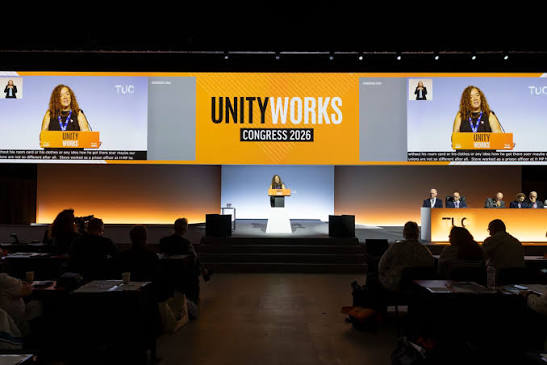
From 13 to 16 September 2026, Brighton was the stage for the 158th annual Congress of the TUC. There, amid motions, banners and debates, the demand that the voice of the working people be heard and prevail was once again raised. We covered the event on the ground, invited by the Revolutionary Communist Party of Britain (Marxist-Leninist) [RCPB(ML)], whose call — entitled precisely “The voice of the working people must be heard and must prevail” — we take as the starting point of this report.
The RCPB(ML) document sets out three central axes: stop paying the rich and invest social wealth in health, education and public services; oppose the militarisation of the economy and the war escalation in Ukraine and West Asia; and expose the cartel party system of Westminster, which behind every change of prime minister keeps the oligarchs calling the shots. These are just demands, and to a large extent they coincide with Motions 75, 76 and 77 passed at the Congress.
However, from a Marxist-Leninist reading — the one bequeathed to us by Marx, Lenin and Stalin on the role of trade unions as transmission belts and schools of communism — our task does not end with the RCPB(ML) call, but begins with it. The call correctly raises “stop paying the rich” and opposition to war; what falls to us to develop is the link that joins that economic protest to the seizure of power by the working class. The TUC, as an apparatus, remains trapped in economism; the question we must answer, inside the movement and not from the sidelines, is the same one Lenin posed in What Is to Be Done?: is it enough for the voice to be heard, or must we organise it, turn it into a political force and aim it at power?
This report gathers what we saw and heard in Brighton, develops the RCPB(ML) call with its strengths and its limits, and contributes from Solidariogb a concrete internationalist perspective: solidarity with Palestine and Cuba, yes; but also direct action in the workshops, the ports and the supply chains to paralyse the imperialist war machine. Because the voice of the working people must not only be heard: it must be organised, and it must prevail.
Anticipated conclusion: The RCPB(ML) call to the 158th TUC Congress is our starting point, not an object of external analysis. It represents a left-wing force within the British labour movement demanding a “radical turn”. Its central demands — stop paying the rich, invest in social programmes and oppose war — have a clear class standpoint. Our contribution, from Marxist-Leninist trade union theory, is to develop what the call does not yet exhaust: the task of the trade union as a “school of communism” and “transmission belt”, and the central Leninist question of the “seizure of power by the working class”.
Report on the 158th TUC Congress: the class standpoint of the RCPB(ML) and the development of its internationalist limits
I. Context and central demands of the RCPB(ML)
From 13 to 16 September 2026, the 158th annual Congress of the Trades Union Congress (TUC) of the United Kingdom was held in Brighton. The Revolutionary Communist Party of Britain (Marxist-Leninist) [RCPB(ML)] issued, both outside the venue and through its central organ The Worker, a call entitled “The voice of the working people must be heard and must prevail!”.
The central arguments of the RCPB(ML) call can be summarised as follows:
1. “Stop Paying the Rich”
This is its most prominent economic programme. The RCPB(ML) points out that the oligarchs, through the lie of “fiscal rules”, are ceaselessly channelling into the coffers of the super-rich the social wealth created by the working class. Its alternative is to reinvest that social wealth in health, education and other social programmes. The RCPB(ML) describes this as the basis of a united front of “the organised working class against the oligarchs, in defence of the interests of society as a whole”.
2. Anti-war and internationalism
The call explicitly supports Motion 75 (against the militarisation of the economy), Motion 77 (support for the BDS movement and opposition to Israeli genocide against the Palestinians) and Motion 76 (end the blockade of Cuba). The RCPB(ML) argues that the organised working class must place itself at the centre of the “people’s anti-war front”, oppose British military escalation alongside the US and NATO in Ukraine and West Asia, and points out that “the militarisation of the economy not only makes war inevitable, but destroys the economy and social welfare”.
3. Criticism of the Westminster “cartel party system”
The RCPB(ML) pours cold water on the optimism generated by the change of prime minister. It points out that, under the current “cartel party system”, no matter who enters Downing Street, the oligarchs continue to call the shots behind the scenes. Therefore, the working class must empower itself, exercise sovereignty and ensure that “the people are sovereign”.
II. The problem of the TUC as a “transmission belt”: what we must develop
The RCPB(ML) call touches on a key question, but does not yet theorise it fully: the nature and tasks of the trade union. Our contribution is to develop that point.
Lenin, in Left-Wing Communism: An Infantile Disorder, states clearly that trade unions are “transmission belts connecting the Communist Party with the masses” and “schools of communism”. Stalin reinforced this in practice: trade unions must not be a force independent of the Party and the State, but “organs of productive emulation” and “auxiliary organisations of the dictatorship of the proletariat”. The core of this theoretical tradition is that the ultimate aim of the trade union is not to obtain better deals in economic bargaining, but to develop the class consciousness of workers in struggle, to turn economic struggle into political struggle and, ultimately, to aim at the seizure of power.
By this criterion, the following conclusions can be drawn from the TUC Congress:
First, the TUC bureaucracy has become gravely detached from its function as a “transmission belt”. The World Socialist Web Site (WSWS) report sharply notes that TUC General Secretary Paul Nowak earns more than £167,000 a year and is simultaneously a non-executive director of the Bank of England, so his class interests are already detached from ordinary workers. UNISON’s main “achievement” at this Congress was the “Insource Now!” campaign and moderate pressure on the Labour government — asking the prime minister to “tax wealth and invest in public services” — which is precisely the typical manifestation of the “economism” and “trade unionism” that Lenin criticised.
Second, the RCPB(ML) call touches on the correct economic programme of “stop paying the rich”, but its formulation on the “empowerment” of the working class remains abstract. Lenin, in What Is to Be Done?, stresses that social democrats must fight within the trade unions for a revolutionary strategy and oppose separating economic struggle from political struggle. The RCPB(ML) calls for the “organised working class” to be the centre of the anti-war front, which points in the right direction, but does not answer a key question: who leads that front? Our task is to build within the trade unions a conscious Marxist current that turns economic discontent into political challenge.
Third, the TUC vote on Palestine is commendable, but we must be wary of “symbolic internationalism”. This Congress passed motions supporting BDS and breaking trade with Israeli settlements. This reflects the internationalist tradition of the British labour movement, and the RCPB(ML) is right to highlight it. However, the core of Leninist internationalism is not moral solidarity, but turning imperialist war into internal class struggle. If the BDS resolutions are not combined with concrete struggles against Britain’s own military industry (such as BAE Systems or the presence of Palantir in the NHS), they risk remaining at the level of “resolutionism”.
III. Our contribution from Solidariogb
Starting from the internationalist tradition of the Solidariogb platform, we make the following complementary contributions:
1. Support the RCPB(ML)’s anti-oligarchic economic programme, but add the dimension of “ownership of the means of production”.
“Stop paying the rich” is necessary, but insufficient. Marx, in Capital, reveals that the extraction of wealth has its root in capitalist production relations themselves, and not only in deviations in fiscal policy. If the working class does not raise the socialisation of key economic sectors — and not only “invest in social programmes” — the demand to “tax the rich” can easily be neutralised by the bourgeois state in the name of “fiscal austerity”.
2. Highlight the “school” function of the trade union: from TUC resolutions to struggle in the workshop.
Lenin stressed that the trade union is a “school of communism”. This TUC passed motions such as “Insource Now!”, which is fine. But the real test is whether those resolutions translate into organised action at workshop level. We must argue that trade union activists must not settle for passing resolutions at Congress, but must organise debates in every workplace on “stop paying the rich”, turning the TUC’s abstract slogans into concrete class demands: for example, refusing to carry out “efficiency” plans that cause mass redundancies, demanding the publication of the company’s military contracts, etc.
3. The criticism of the “cartel party system” must be raised to a higher level.
The RCPB(ML) correctly points out that the Westminster system cannot produce qualitative change. But the Leninist answer is not the abstract formulation of “empowering the working class”, but building an independent political organisation of the working class. We must call for the British working class to build a mass political tool, independent of the Labour Party, based on trade unions and community organisations, whose programme includes: leaving NATO, nationalising military industries to convert them to civilian production, and applying progressive taxes to the super-rich until their wealth is substantially reduced.
4. Make internationalism concrete: from Brighton to Gaza, from Cuba to Palestine.
Supporting Motion 76 (end the blockade of Cuba) and Motion 77 (BDS) is correct. But we must go further: the British trade union movement must launch campaigns of refusal to handle weapons destined for Israel and refusal to provide services to military companies. This is not “symbolic internationalism”, but the contemporary form of what Lenin called “turning imperialist war into civil war”: paralysing the imperialist war machine at the supply-chain link through the direct action of the working class.
Final judgement
The RCPB(ML) call at the 158th TUC Congress is our starting point, not an object of external analysis. It represents the healthy force of the British labour movement that opposes the oligarchs, opposes war and defends international solidarity.
However, from the strict Marxist-Leninist criterion — and following the method of Lenin in What Is to Be Done? — the question is not to judge the trade unions by what they presently are, but to set out what they should do if they are to fulfil their historic role. Lenin did not content himself with describing the trade union movement as economistic; he set out the tasks of the revolutionary current within it: to go among the workers, to raise the economic grievance to the level of political consciousness, and to build within the unions an organisation capable of leading the class beyond the horizon of bargaining with the employers and their state.
By that standard, the trade unions should do what they currently do not. They should not merely pass resolutions calling on the TUC to “take a stand”, but should organise in every workplace a conscious current that links the demand to “stop paying the rich” to the question of who holds state power. They should not stop at exposing the “cartel party system” as a description, but should draw the practical conclusion Lenin drew in 1902: that the working class needs its own independent political organisation, built in and through the mass movement of the unions, capable of converting economic struggle into political struggle and aiming at the seizure of power. In short, the unions should be schools of communism and transmission belts — not merely machines for bargaining — and their resolutions should be programmes of action for building the subjective factor in the workplaces, not manifestos of demands addressed to a bureaucracy that has already shown it will not act on them.
Our task, then, is not to applaud the TUC’s resolutions from the sidelines, but to press the unions to become what they should be: instruments of class struggle, not appendages of a Labour government that administers capitalism. “The voice of the working people must be heard” — but being “heard” is not enough; the unions must organise that voice and, ultimately, aim it at power.
Please download the RCPB-ML document below.
Discover more from SolidarioGB
Subscribe to get the latest posts sent to your email.
